

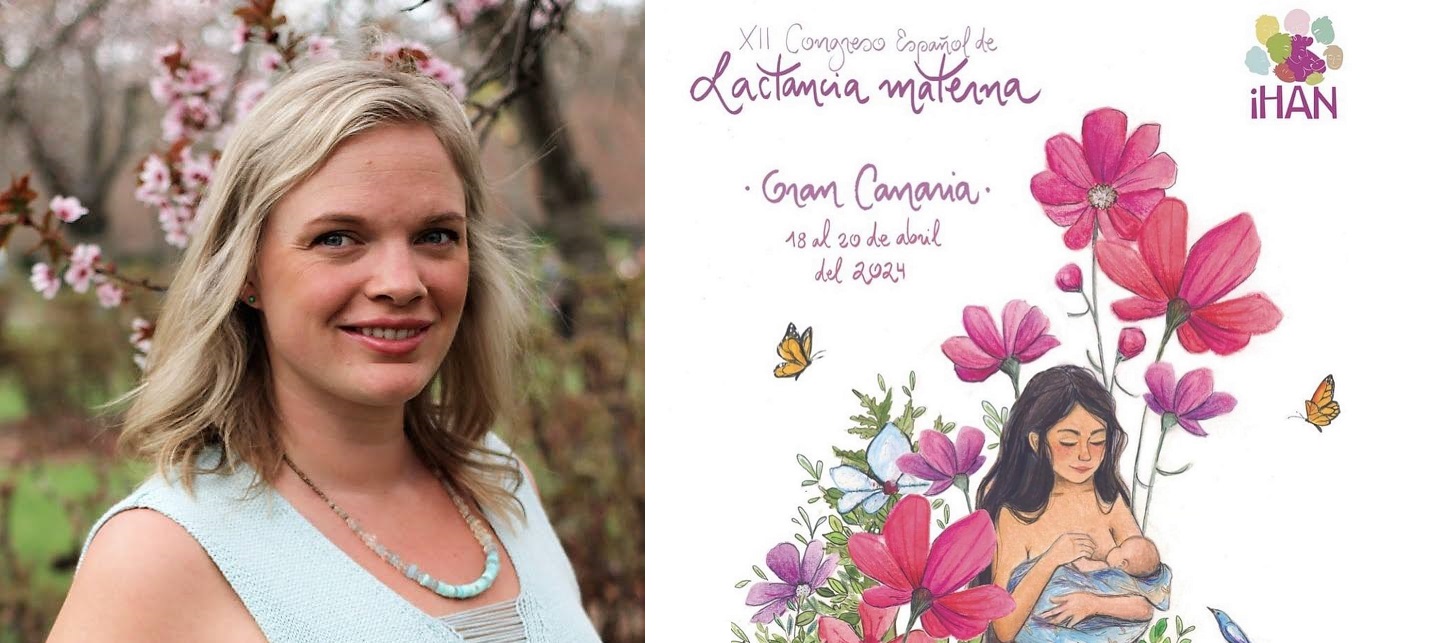
Dear Aubrey, first of all I would like to congratulate you on your presentations during the 12th Spanish Breastfeeding Conference of IHAN, at Gran Canaria in Spain, on April 18-20, 2024. The structure of your lectures and the information you shared were fascinating. Below you may find the questions of our interview.
Regarding your first topic “Virtual consultations in
lactation”, could you please tell us more about what a virtual
consultation is and how it is done?
A virtual consultation is meeting with a family via use of technology, usually a video call, instead of in-person. It usually takes place via a video call platform like zoom.
What is the procedure before a virtual consultation (consent forms, necessary personal information, payments etc)?
In my private practice when setting up a virtual consultation a family contacts me asking for this type of consultation (they usually don’t live nearby), then we agree on a time, I create a google calendar event and add a zoom link and I send over a consent form with intake questions prior to the session to help me prepare and understand the situation. I accept payment via paypal or direct bank transfer, I ask this be done prior to the consultation when possible. Afterwards I sent a Care Plan as well as a receipt to submit to insurance if need be.
What is the cost and the duration of a virtual consultation?
In my private practice the fee is 60 euros for a 60 minute consultation with unlimited follow up support. Most of my consultations come through an app where the consultations are free of charge to the user.
Who needs a virtual consultation in lactation and how does this kind of consultation help?
I find I can do almost any kind of consultation virtually! I had my doubts as well and was quite nervous to begin during Covid. My first consultation was twins and I felt underprepared. Since then I have attended several talks on the topic and convened with coworkers to make the experience better for everyone. I see families starting off breastfeeding, troubleshooting common issues, tongue tie, low supply, mixed feeding, back to work/pumping, starting solids, weaning – you name it! I think this type of consultation can help families who may not have skilled lactation help around, or who may not be able to get out of the house easily, it can also help those who are looking for experts in certain topics (in my case it is Insufficient Glandular Tissue for example). When these consultations are offered for free, as they are at the app I work for, I think there’s no such thing as “too much” lactation help! And we can take the time whereas sometimes nurses or midwives in hospitals might be too busy to be able to devote a lot of time to a consultation or understand how past medical history may affect the dyad.
What is the necessary equipment that an IBCLC and a parent need, in order to do a virtual consultation?
For the parent: a phone or a computer or both! If parents log in from both I can see more angles when the baby is latching. (Both the latch and the position). They are in the comfort of their own home and they can easily show me all the supplies they have for baby, where they normally nurse and how! This is a plus. For the IBCLC – I find having some pillows around, a baby doll, a fake breast to be the essentials. For me I’ve found it helpful to have a mouth puppet, a nipple shield, a bottle, a pumping flange, a silicone milk collector, a supplemental nursing system, a curved tipped syringe, a small spoon and a shot glass (to show cup drinking) to be occasionally useful.
How can we ensure our clients about the safety of their personal information, videos and photos, during virtual consultations?
The same way would assure them whether their information was on pieces of paper or in a database at the office. I take annual health information protection training and go through measures to keep this safe (part of my consent form has the parent sign off that they can see my policies on HIPAA and GDPR compliance on my website). Documents sent to parents are locked and can only be viewed by the email address provided. Some parents choose to communicate via whatsapp with me which is fully encrypted end-to-end. Videos and pictures are not saved, they are deleted, unless given authorization for education purposes. Documents are stored in google drive (also hipaa compliant) and I have 2 factor authentication to access both my phone as well as my computer.
What happens during a virtual consultation? Is there a general appointment structure that you follow?
I use the intake questions to help guide where the consultation goes. I have their past medical history, data on weight gain/intake/output and their goals for feeding. When I hop on the call I meet them, and ask open ended questions to help clarify what they would like from meeting with me and we try to get there together, make a plan that I share with them and modify if necessary. Sometimes I start with “Tell me how feeding your baby has gone from birth until now” and just with that information, it tells me a lot about which directions we can focus on. I have my care plan open in front of me so I can jot down notes of where to focus, or questions I’d like to go deeper on. Before the call I highlight any areas I would like clarity on to be sure not to miss those key pieces of information.
What if a parent doesn’t want to share photos or videos of herself/himself and/or the baby, but needs your help?
This is probably the exception. In our technological days I have only had 1 family that I can remember that didn’t want to turn her video on for the lactation call. And I do have quite a few families who decline being able to use photos/videos of their baby for education use. The rest consent to share with me. I can recall the family who decided to keep video off was in Egypt and I’ve had many families in other countries such as India where they will keep video on but not want me to see the baby feed. As IBCLCs we also need to be culturally sensitive. In this case we really have to work with everything else we are given to ensure baby is getting enough. And ask great/thorough questions about what feeding is like, how it feels, what the sounds are like, how baby is held, what diapers and weight are looking like. Even “the perfect elements” parents leave feeling reassured and having their questions answered and a plan in place! Some families who didn’t feel comfortable turning video on during the call feel safer to do so in a video afterwards, and so I suggest this as an option as well.
What do you do when you feel that the virtual consulted parent or baby need hands-on help or any other special care?
I refer! It has helped me a lot to get to know local healthcare systems and how referrals may work. That being said I often refer back to the midwife or doctor for things like thrush/mastitis diagnosis, to a pediatric dentist or ENT for tongue tie diagnosis, and to a bodyworker like an osteopath or a chiropractor to see about tension and structurally related feeding difficulties. I have also referred to local IBCLCs when I could see that a family needed a second opinion or could really use some hands-on support.
What happens after the consultation? Do you send written or visual information to the parents? Do you ask for feedback?
Yes! I send a plan of care that includes some simple steps accompanied by pictures and videos (there are all different types of learners!). I have a place for feedback in every Plan of Care email that I send. I make sure families know that these consultations are for them and not me, and therefore this is a working plan that can always be changed, and I will always be there to support their feeding choice no matter what.
Do you follow up your clients? If yes, do parents contact you to book a follow up appointment or do you contact them?
I offer unlimited support via my private practice which often includes voice memos/videos/photos back and forth to each other (even months later). I’m not very good about “ending” an episode of care. This way I find I don’t need to do a ton of follow-up appointments (although it is unpaid time for me). I find this to be the case with the app I work for as well, so it’s the same whether the family pays or not. That being said, they are some families who love getting on a call, and I oblige.
Can you share with us a unique virtual consultation story? Perhaps a case that was very different, difficult or interesting?
I think sometimes as IBCLCs we can go into things expecting them to be complicated. Sometimes returning to basics can shift the entire situation. For example, I recently had a family where mom had very painful nipples, baby wasn’t latching any longer as it had been causing pain and wasn’t gaining weight at the breast and mom was pumping and the baby was getting a lot of formula. In these types of cases it can often be easy to think “tongue tie”, or feel overwhelmed by how many steps it may take to get the family to their goal of exclusively nursing. In this case it just took a bit of sleuthing! I found out that mom has been feeding with a nipple shield that was much too large and so the baby was just at the tip and not getting much milk. The flanges the parent was using to pump were much too large and causing the nipple pain. When she started using a correct size flange and some lubrication the pain went away, her nipples healed and we started little by latching, getting baby to latch without the shield and slowly decreasing the amounts of formula, until weight gain and output showed us she was getting enough at the breast! It’s always worth double checking flange sizes, type of pump, if a shield is being used, etc. This baby is still nursing and these parents have worked hard to get there (little by little) and feel happy to be there.
What would you tell IBCLCs and parents that are willing to try but have never done a virtual consultation in lactation?
For parents: if you’re not finding what you’re looking for (example unique situations that aren’t improving) and breastfeeding is quite important to you, don’t hesitate to look beyond where you live to find experts in certain subjects. I’m a big fan of “If it’s not broken, don’t fix it”: if you’re surrounded by dynamic and nurturing and knowledgeable lactation support, then enjoy being in that space.
For IBCLCs: I did a presentation on this topic including keys for success and I’m happy to share it (for free of course) if you email me! A bit of preparation and practice and I do feel we can create open, kind, welcoming spaces and create breastfeeding change and reach more families who might not have had access to your care.
Thank you for your answers Aubrey. Regarding the second
topic, “Supporting families with insufficient glandular tissue”, could
you tell us a little more about IGT? What is it, who is affected, why
does it happen to women, how common is it etc?
Insufficient Glandular Tissue is an issue that 5-15% percent of the population are affected by in which there isn’t enough growth of milk making tissue in the breasts to make a full milk supply for the baby. This is considered “primary low milk supply” (This is outside of feeding issues like tongue tie, decreased milk removal, hormonal issues etc). There are several times in the life of a woman where glandular tissue growth might be affected; in utero, adolescence (the most growth) and in pregnancy. Usually in women with IGT we see widely spaced breasts with nipples that point out and down (there’s often some missing fatty tissue on the inside and lower part of the breast), little to no breast changes in pregnancy, little to no milk coming in after birth (despite adequate stimulation) and marked asymmetry (among a few other things, these are the 4 most common). We need more research as to why it happens but we often see this when hormones are affected during adolescence (overweight, pcos, insulin resistance, exposure to endocrine disruptors, eating disorders, etc).
Why did you decide to increase people’s awareness on this topic?
I myself have IGT and even as an IBCLC who suspected the issue myself (prior to pregnancy and while pregnant), I received very poor support, and felt isolated, sad and angry (amongst many other things). Why hadn’t anyone ever told me about this even though I had annual breast exams? Why did it take studying to become an IBCLC to finally see a photo of what my breasts look like and put a name to it? And why was everyone giving me false hope? I joined online support groups and saw that there are so many other parents who suffer and struggle to find competent care so I decided to be an advocate for them, a voice for them to help change the medical community and how we support these families.
How is IGT diagnosed and who is responsible for the diagnosis?
For the moment it’s a diagnosis of exclusion, so we want to first rule out any other confounding factors (inadequate stimulation, oral restriction, retained placenta etc) BUT we almost always have those indicators above. We as IBCLCs can open the conversation and give resources. There is no “diagnostic criteria” at the moment which means many parents are self-diagnosed, or diagnosed by a knowledgeable midwife, or doctor. A plastic surgeon was finally the one who told me “yes, you have severe hypoplasia” which did feel validating after seeing so many professionals who knew nothing about it. I imagine they see many cases of IGT as many women with “underdeveloped breast tissue” may seek an augmentation. This is another key point as an IBCLC – to always ask why a parent chose to have an augmentation.
How do parents with IGT feel before and after the diagnosis? Why does it matter to get an IGT diagnosis?
As part of a talk I gave for ILCA and LLLI (and now IHAN) I conducted a survey of families with IGT regarding many aspects of feeding and the emotional consequences. Oftentimes beforehand families are feeling like they are doing something wrong, feeling like a failure, they all wanted so badly to breastfeed and despite all their efforts (often seeing multiple healthcare providers and triple feeding, taking supplements etc) they are not able. None of them planned to give formula. It’s a real grief families feel for the experience they are not allowed and weren’t prepared for. After the diagnosis families often feel validated that it wasn’t anything they were doing wrong and just a failure of their body (Think about a type 1 diabetic, there’s no shame in the fact they can’t produce insulin). But then there’s the phase of acceptance and planning on what is realistic for each dyad regarding feeding/supplementing. Without a diagnosis I see families still thinking of ways that maybe what they’re doing isn’t right, maybe if they just tried X/Y/Z that they could make enough milk for their baby (so again the feelings of guilt and self-blame). (Mind you, these families often have been triple feeding for months with a hospital grade pump and taking many supplements including prescription ones, have has blood tests done, tongue tie procedures, seen bodyworkers etc).
How can we -as IBCLCs- help parents with IGT? How can everyone else help?
The list is long! We as IBCLCs can start by antenatal education on the topic, including it in breastfeeding prep classes. Or if we notice a woman has had no breast changes in pregnancy then she needs to be watched closely once baby is here. We need to help them make realistic plans and check in regularly. Underfeeding a baby or giving a plan to triple feed for months with no direction to stop are not helpful. If they want to procure donor milk we can help support them in this endeavor. These babies need to eat so it’s our job to help them set up an SNS, or talk about responsive and loving bottle feeding, and make sure their pump works well (if that’s what they want to do) and also educate on proper formula preparation. For an exhaustive list, I’m happy to share my presentation on this topic if you’d like to email me! For everyone else: saying that “every woman can exclusively breastfeed” is just not true. We would never say that every pancreas makes insulin or every womb can get pregnant. Perpetuating that myth has been shown to be unhelpful. Families need education and information to make an informed decision. I love Diana Cassar Uhl’s quote on this: “It is time for the lactation support community to embrace that there may be circumstances of our modern times – environmental influences, diet over time, and disease states – that make human lactation a less stable, less reliable process of our biology than it has had to be in order for our species to be sustained in previous millenia” We need more research on WHY this is happening. A recent study from Caiomhe Whelan suggested including antenatal breastfeeding classes that address IGT, more training for healthcare providers and IBCLCs on IGT, including causes, prevalence, counseling skills, and care plan development that balances milk supply with emotional well-being. And I completely agree!
If a woman suspects she has IGT, what should she do?
This is a hard one as there are still many IBCLCs and healthcare providers in general who aren’t familiar with the topic. I LOVE the low milk supply foundation website as well as the instagram “lowsupplymom” – a wealth of information! It would be worth contacting an IBCLC who has been recommended who is knowledgeable in this topic (maybe as a referral from one of these sites or an online support group or directly asking an IBCLC if they have experience in supporting IGT families).
What can a mother do (prenatally and postnatally) if she has
IGT? Are there things to do, in order to help the mammary gland evolve
or have better function?
Antenatal colostrum harvesting is one thing. This also gives a skill that doesn’t have to be learned once baby arrives. There are some supplements pregnant people can take (see the IGT support group on facebook) that are thought to potentially help increase glandular tissue. It may also be helpful for parents to purchase an SNS, and be able to access a high quality breast pump. It would be great for parents who suspect this to join online support groups or find an IBCLC to support them in pregnancy and after the birth so they feel “heard” and supported from the beginning. There is a large emotional wellness piece to this diagnosis.
Can women with IGT breastfeed?
Yes! Each case is a bit different to what extent. There are some families who can stop supplementing when babies start solids and others who still need to supplement (with donor milk or formula). But most parents with IGT are still able to find fulfilling nursing relationships. This might be via using an SNS, also bottle feeding, or doing “snacks and dessert”.
What are galactagogues? Do they help in cases of IGT? Are there some galactagogues that are more helpful than others, in IGT?
Galactogogues are food or herbs that are thought to either increase glandular tissue or increase the hormones that make breastmilk or help increase the milk in other ways. There are too many to name! Some can be taken during pregnancy and others once baby has arrived. They are NOT one size fits all, as some can be harmful when coupled with certain medications. I highly advise parents to check out the Low Milk Supply Foundation and the IGT Support Group Facebook page for more resources on galactogogues. As IBCLCs, we also need to be careful and counsel on expectations: there is no magic wand for insufficient glandular tissue. Although low prolactin is not the issue, some parents find taking prescribed motilium/domperidone to be helpful (of course this needs to be under the direction of a healthcare professional).
Would you like to share with us a unique case of IGT? A different, interesting or eye-opening IGT story.
I think it’s interesting that often we are told “hypoplasia or IGT are the only reasons a woman can’t breastfeed” but breastfeeding exclusively is not the only criteria for breastfeeding. In the survey I conducted, the rate of parents still nursing beyond 2 years was higher than many national averages!